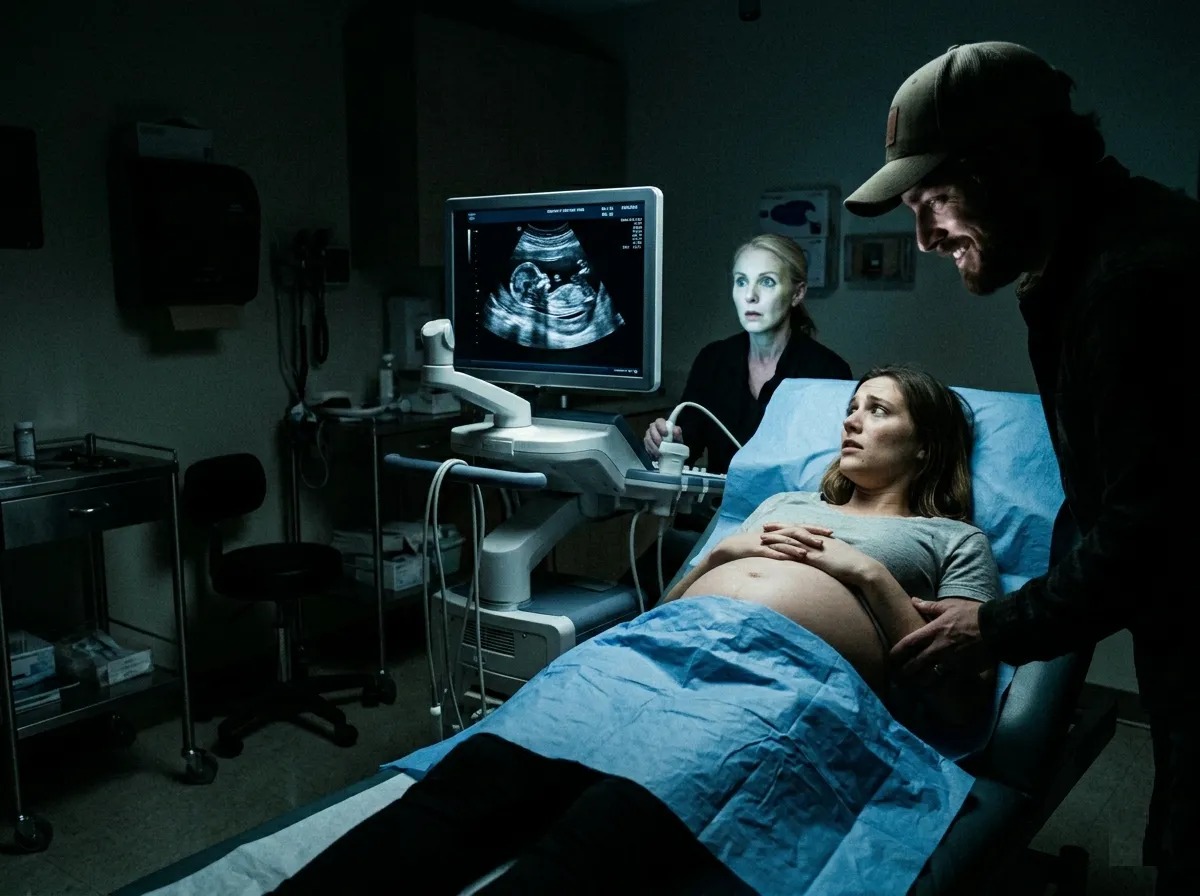
The room was dark except for the soft blue light of the ultrasound monitor. I lay back on the crinkly paper-covered bed, one hand resting on my belly, while my husband Adrian stood beside me, beaming as if this were the best day of his life. For weeks, he had been unusually attentive—brewing my tea, scanning ingredient labels before I ate, urging me to rest as though I were carrying something made of glass instead of a baby. When the ultrasound technician turned the screen toward us and highlighted the baby’s tiny profile, Adrian squeezed my shoulder and whispered, “That’s our little girl.” I nearly burst into tears.
Then Dr. Meera Shah walked in. She glanced at the image and froze so abruptly that the stool behind her bumped into the wall. It lasted only a second, maybe less, but I caught it clearly—something far more personal than professional concern. She leaned in, magnified the image of the baby, and her expression shifted again. Adrian chuckled and asked if everything looked normal. Dr. Shah didn’t reply immediately. Instead, she asked the technician to print a few still images, then resumed speaking in a normal tone.
Adrian’s phone rang a moment later. He kissed my forehead and stepped into the hallway. As soon as the door clicked shut, Dr. Shah lowered her voice. “Listen carefully,” she said. “I shouldn’t be telling you this the way I’m about to, but you need to hear it.” My mouth went dry. She held my gaze for a long second, then said, “You need to divorce your husband.” I stared at her. She looked back at the ultrasound, then at me. “And whatever you do,” she whispered, “don’t tell him I said this…”

For the rest of the appointment, Dr. Shah acted as if nothing unusual had happened. She measured the baby, confirmed the growth was normal, printed three glossy photos, and spoke to Adrian in that calm, reassuring voice doctors use when everything is fine. By the time we reached the parking garage, he was already discussing nursery paint colors and whether we should finally tell his parents we were having a girl. I answered when I had to, but my mind was still trapped in that room. Divorce your husband. Don’t tell him I said that.
At a red light, Adrian glanced over. “You’re quiet,” he said. “Did the doctor say anything while I was gone?” His tone was gentle, but there was an undertone—something that made a simple question feel like a trap. I forced a smile and said she’d only warned me about swelling and stress. He held my gaze a beat too long, then nodded and turned back to the road. When we got home, he insisted I go upstairs and rest while he made dinner. Twenty minutes later, he came in carrying a tray of soup and my phone in his other hand. “Claire called,” he said, referring to my older sister. “I didn’t pick up. You don’t need her upsetting you.”
After he left, I checked my phone. Claire had indeed called. There was also a text reminding me that I’d forgotten to pick up my prenatal vitamins. No signature, but none was needed. I stared at the screen until my pulse began to pound in my throat. I knew what I had to do. Downstairs, I could hear Adrian moving through the kitchen, opening drawers, humming softly to himself as though our life were perfectly ordinary.