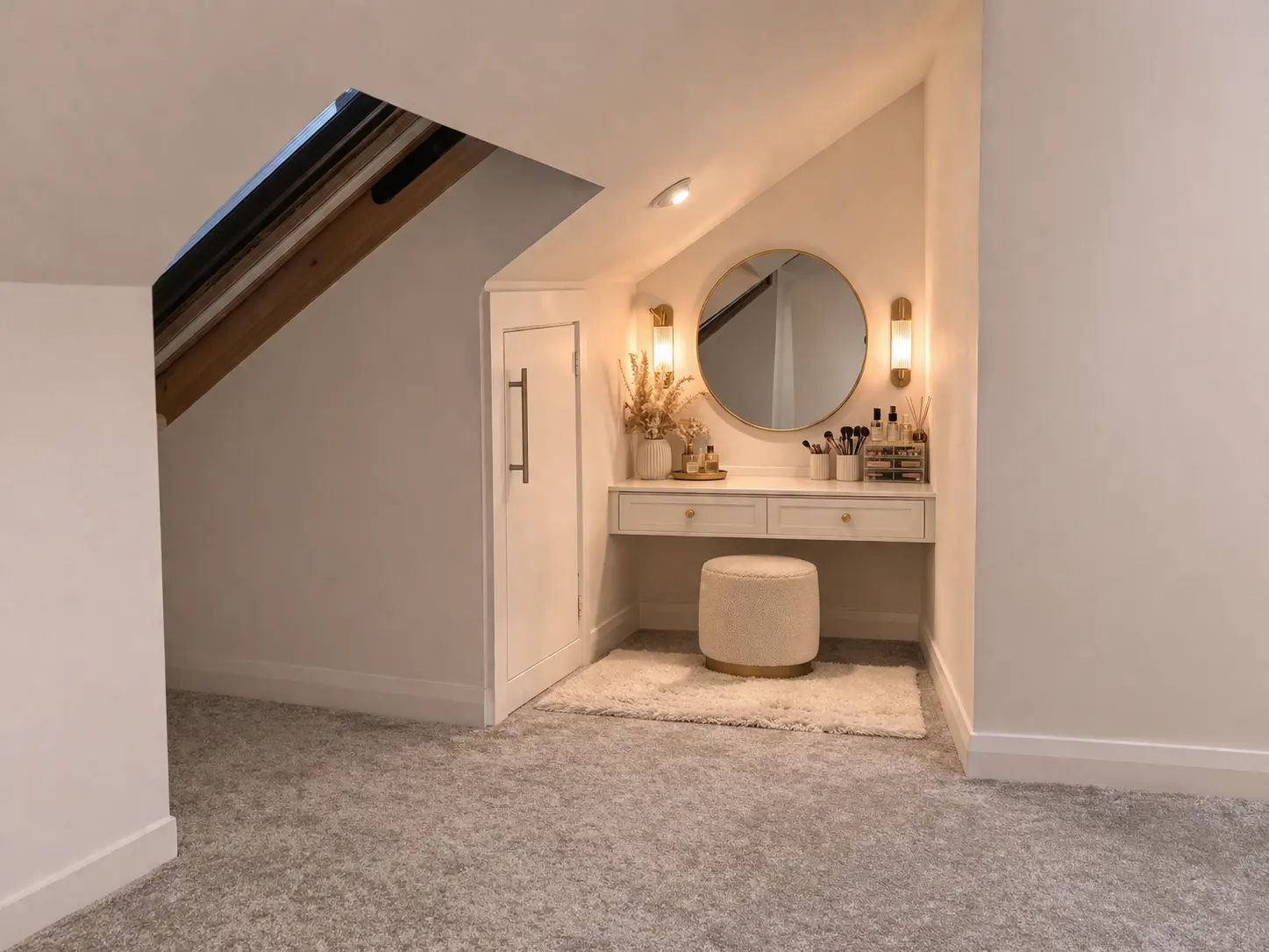
One of the earliest ideas was surprisingly straightforward: a vanity. At first, it seemed unlikely to work. The space felt too tight, too oddly shaped. But the more people thought about it, the more sense it made. The sloped ceiling actually created a natural frame, and the depth of the nook was just enough for a compact setup. All it needed was the right arrangement. A floating counter would keep things light and uncluttered. A round mirror could soften the sharp angles. And with proper lighting, the whole corner could go from dark and forgettable to warm and purposeful.
Suddenly, what once felt like an afterthought began to feel meaningful. It wasn’t about forcing something into the space—it was about choosing something that fit it perfectly. And that’s when people started realizing something key: this wasn’t just a weird leftover area. It was a space that could actually be shaped into something useful—as long as you stopped trying to treat it like a normal room.
Then someone had a completely different take. What if it wasn’t just decorative? What if it was functional? That’s when the coffee station suggestion arrived—and it immediately shifted how people viewed the space. Instead of trying to make it feel like part of the main room, the idea leaned into what it already was: a tucked-away little corner. Which made it ideal.
A small cabinet, a coffee machine, a few cups, maybe even a grinder—everything you’d need, all in one compact spot. It wouldn’t eat up valuable kitchen space, and it would feel like its own little setup rather than something squeezed in. Almost like a hidden gem. The more people imagined it, the more it worked.
The sloped ceiling no longer felt like a limitation. It made the space feel cozy. Intentional. Separate from everything else. And that’s when the suggestions began to evolve. People weren’t trying to “fix” the space anymore. They were starting to see it as something to design around.
Next came one of the most visually striking ideas yet. Instead of hiding the awkward shape… someone proposed turning it into a display. At first, it sounded odd. But the more people pictured it, the more it clicked. The angled ceiling could actually guide the design, creating a natural layout for shelving that followed the shape of the space rather than fighting it.
And then it hit: shoes. Bags. Accessories. Not just stored away, but showcased. With the addition of soft lighting and clean shelves, the nook could transform into something that looked almost custom-built—like a boutique-style feature right inside the home.